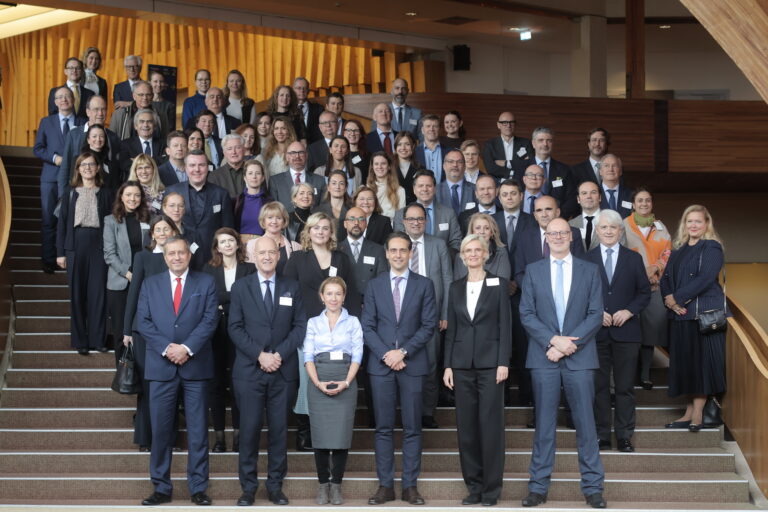
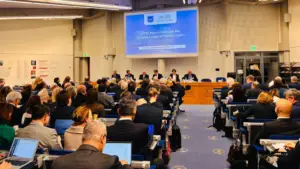
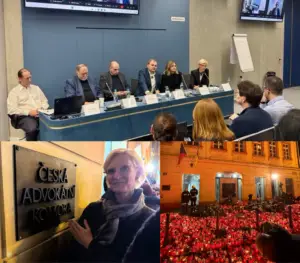
At the Council of Europe in Strasbourg, the CCBE brought together judges, lawyers and legal experts for the conference “Digital Justice and Fundamental Rights: Safeguarding the Rule of Law in a Technological Era”. Around 400 participants, in person and online, followed three panel discussions that explored the latest developments in the digitalisation of justice and critically addressed its challenges and future trajectories.
CCBE President Roman Završek opened the conference, affirming that technology is changing the world in which justice operates, but the principles of justice must stay the same. The CCBE was pleased to host Gianluca Esposito, Director General of Human Rights and Rule of Law of the Council of Europe, for a keynote address on the digitalisation of justice and the protection of fundamental rights in Europe. He stressed that justice systems must be independent, reliable and accessible, and that Europe must therefore stay in control of its data and digital infrastructure, much of which private companies currently hold. He also highlighted the role of lawyers as responsible users of technology who protect their clients’ interests and rights, and the importance that the Convention for the Protection of the Profession of Lawyer has also in this context.
In line with this reflection, the first panel addressed Europe’s digital sovereignty, which is crucial to guarantee the independence of the judiciary. Moderated by CCBE First Vice-President Alex Tallon, the discussion started from a key question: can Europe preserve its human rights framework if the technologies its justice systems rely on are controlled elsewhere? ICC Judge Beti Hohler answered from her personal experience as a judge under US sanctions as well as from the ICC as an institution under sanctions, living in constant uncertainty while the Court’s work continues and the Court is busier than ever. When the ICC mapped the technologies supporting its internal processes, it found that 92% of them depend on the US. This shows that institutional resilience starts with continued access to technology, because a court that cannot keep its digital independence is not independent. The ICC may not be the last court targeted by sanctions, she warned, so this question concerns all legal systems and the whole legal profession. To preserve operational autonomy without giving up innovation, she proposed three guiding principles: institutional control; judicial independence, since technology must never determine the outcome of judicial proceedings; and equality of arms and procedural fairness.
Responsibility does not lie only with institutions. ECtHR Judge Vasilka Sancin recalled that states have positive obligations, such as requiring companies operating on the European market to carry out human rights due diligence. Judges and lawyers, in turn, must exercise their own due diligence to avoid “cognitive surrender”, the tendency to trust what technology produces without question. There is no quick fix: proper training, dialogue and availability of time are essential so that judicial work, though assisted by technology, stays mainly human. She also recalls a key aspect when addressing these matters: “AI systems work for correlation, not causation. For our job, causation is fundamental”.
How can this be put into practice? Jan Spoenle, judge in Germany and member of the CEPEJ working group on Cyberjustice and AI, presented Council of Europe guidelines and tools and shared Germany’s justice cloud as a best practice. There, the federal government and the states are building a shared community cloud on open-source technology, managed by the state administration rather than private companies, with a secure network accessible only to the judiciary. Improving digital sovereignty for the judiciary, he concluded, is not easy, but it is possible.
The second panel looked at the use of AI in justice systems and how it is changing the daily work of judges and lawyers, exploring how to strike the right balance between efficiency and fundamental rights. Moderated by CCBE Second Vice-President Imbi Jürgen, the discussion opened with a clear position from ECtHR Judge Hugh Mercer: the Court “is not pro or against AI, but pro human rights”. AI can assist judicial work, but it cannot replace judicial deliberation, as it may produce hallucinations and repeat biases and discrimination. Yet AI is not all risk: it can help, for example, with high volumes of small cases, and, as the saying goes, “justice delayed is justice denied”. Courts must be ready to innovate, provided that independence, impartiality and the right to a fair trial are protected. Getting this balance right requires new skills, which is why the Court is rolling out training on the risks and opportunities of AI.
Training was the focus of Ingrid Derveaux, Secretary-General of the European Judicial Training Network (EJTN). She presented survey results showing a large generational and cross-border gap in Europe. She also set out five key competences that justice professionals need when using AI, under the acronym JUDGE: Justify, Understand, Doubt, Guard and Evidence. Training should show, not just describe, and bring together judges, lawyers, experts, legal tech companies and academia, as an interdisciplinary approach is key. She presented a few best practices from the EJTN’s experience, such as its webinars and its digital ambassadors programme, which help pass on the knowledge and skills acquired through training within each country. In her words, “AI can assist the judge, it cannot be the judge”.
For lawyers, the change is already visible in the courtroom. Closing the panel, Dominic Gerstberger, Chair of the CCBE IT Law Committee, noted that AI-generated applications are adding to courts’ workloads, making the role of lawyers as a filter between the public and the court even more important. Lawyers must protect professional secrecy by knowing how and where client data is processed. Under Article 6 of the Convention, parties must know when and how AI has been used to support a judgment. Legal education must also adapt to teach future lawyers when not to use AI and which tasks must remain their responsibility, because AI has already arrived and the real question is under which conditions it should be used.
The final panel turned to explore how to communicate, protect and defend the rule of law in a digitalised society, where narratives spread very fast online and polarisation, fed by digital platforms and AI, is harming democracy. Moderated by CCBE Third Vice-President Noemí Alarcón Velasco, the discussion showed that judges and lawyers have a shared role to play. ECtHR Judge Anna Adamska-Gallant drew attention to developments in the jurisprudence of international courts, including the Inter-American Court and the European Court of Human Rights, on the role of judges in countering autocratic tendencies. She observed that “for judges, the right to speak in defence of the rule of law, human rights and democracy can, given their special position, become a duty”. Without trust and independence, courts cannot work, and lawyers are essential to building that trust. Jeff Lewis, Deputy Vice-President of the Law Society of England and Wales, described justice as a vital public service and independent representation as a safeguard for all. Through their work, lawyers help the rule of law connect with people. AI offers real opportunities to improve legal services, he said, but it does not always deliver justice. Sharing the example of the Law Society of England and Wales, which has developed its own AI strategy, he underlined the importance of such guidance for lawyers. Both speakers emphasised that the rule of law may seem abstract, but in reality it is part of people’s everyday lives. Judges and lawyers have a responsibility to communicate more, and better, so that people understand what it means and why it matters.
The CCBE was honoured to welcome Mattias Guyomar, President of the European Court of Human Rights, for the closing remarks. He highlighted the key messages of the day and reiterated the importance of support and cooperation between judges and lawyers.